OnePay Later
By Darnell Whitfield, Personal Finance Educator, former Auto Service Advisor
The Hour After the Shop Calls
The repair call compresses a four-figure decision into an adrenaline hour — and the entire skill is slowing that hour down, because every mistake I watched from behind the service desk happened at panic speed.
Nine years as a service advisor taught me the anatomy of the worst hour in household finance. The phone rings mid-shift: it is not the brakes you brought it in for, it is the brakes plus two tires plus a control arm, and the number is $1,640, and the car is on the lift, and the shop closes at six. Everything about the moment is engineered — not by villains, just by circumstance — to produce fast decisions: the disassembled car creates urgency, the unfamiliar vocabulary creates deference, and the number lands on a day that was already busy. I watched a decade of customers meet that hour. The ones who got hurt were almost never cheated; they were rushed. The ones who did well had, or faked, one skill: they slowed the hour down.
This guide is that skill, written from the other side of the counter, arranged in the order the hour actually unfolds — and it pairs with the fuller Auto Repair category page on OnePay Later, which handles the sizing math this guide will lean on when the OnePay Later moment arrives. First rule, before any section: nothing about a car on a lift expires at six o'clock. The shop will keep it overnight. Knowing that single fact returns the hour to you.
The First Fifteen Minutes: Get It in Writing
Before deciding anything, get the itemized estimate sent in writing — parts, labor, diagnostics, per line — and the callback policy for overages; a legitimate shop provides both without friction.
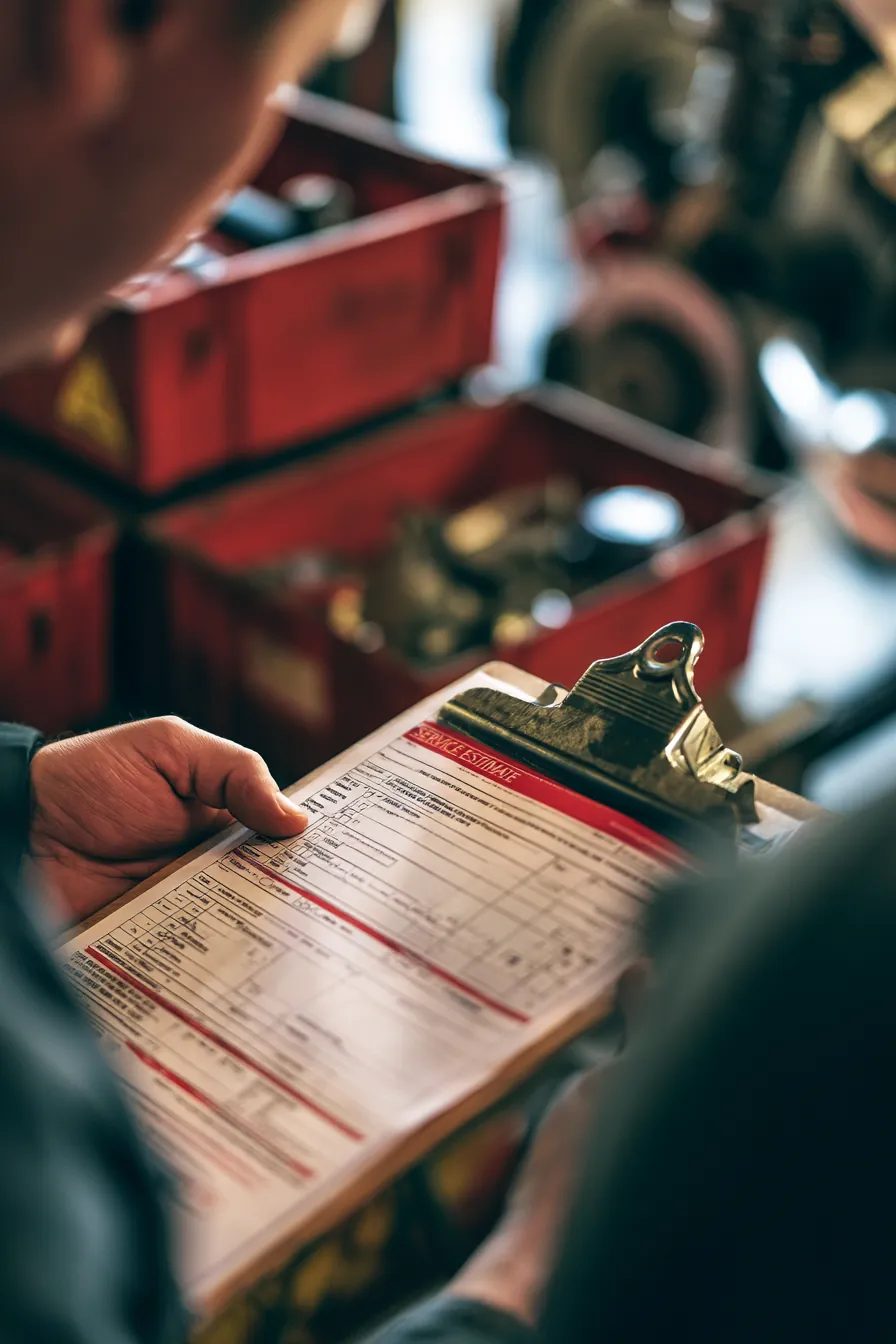
Your first fifteen minutes have exactly one deliverable, and it is not a decision — it is a document. On the call, say the sentence I coached a thousand customers toward: "Email me the itemized estimate and I will call you back within the hour." Itemized means parts, labor, and diagnostics as separate lines per repair, the anatomy the category page teaches — and the request is routine, not adversarial; shops generate these estimates in their software with two clicks, and the good ones send them before being asked. While you have them, ask the second question: "If you find more once you're in there, what's your policy?" The answer you want is a callback threshold — nothing beyond the estimate without your approval — and you want it noted on the work order.
Fifteen minutes, two asks, zero commitment. What you have gained is everything the panic hour tried to take: a number that holds still, a vocabulary you can search, and a document you can show to a second shop, a knowledgeable friend, or the fair-price ranges ten minutes of searching will produce. Friction on either ask, from any shop, is the loudest data of the day — and the moment to remember that tow trucks are cheaper than regret.
Triage: What Today, What This Month, What Never
Sort the estimate's lines into three buckets — safety items fixed now, wear items scheduled this month or next, and advisories declined for later — because the invoice you finance should contain only the first two.
Estimates arrive as lists, and lists hide the fact that their lines have wildly different clocks. Sort every line into three buckets before pricing anything. Today: anything that stops, steers, sees, or cools — brakes at limits, tires at the wear bars, steering components, lights, active leaks. These carry the category page's hard rule: fixed now, financed if necessary, no exceptions worth your family's Tuesday. This month: genuine wear items with visible runway — the pads at forty percent, the belt due by mileage — which deserve scheduling on your calendar, not the shop's. Never-mind-for-now: the advisories every inspection produces, from cabin filters to cosmetic seepage, which are legitimate observations and optional purchases.
Triage is where the $1,640 call routinely becomes a $900 decision plus a $400 appointment next month plus $340 of declined advisories — same honest shop, same honest list, different clocks respected. And triage is what the plan should be sized to: the today bucket, plus any this-month items you choose to bundle while the car is already open, and nothing else. Financing an advisory is how surprise repairs grow surprise schedules.
The Counter Conversation, From the Other Side
Service advisors respond to specific questions with specific answers — ask about aftermarket part options, diagnostic credit, and line-item priorities, and the estimate routinely improves without a single adversarial word.
Let me hand over the desk's own playbook, because informed customers were my favorite customers and they paid less. Three questions move estimates, none of them hostile. "Is there a quality aftermarket option for this part?" — on many components the answer trims real dollars, and advisors quote OEM by default, not by malice. "Does the diagnostic fee credit toward the repair?" — at many shops yes, if you proceed, and asking costs nothing. And the triage question, phrased exactly: "If this were your car and your money, what has to happen today?" — a question advisors answer more honestly than any brochure, because it invites the professional out from behind the script. What never worked, from either side: bluffing expertise, opening with accusations, or grinding on labor rates, which are posted and non-negotiable nearly everywhere. Specific questions, notepad visible, callback policy on the work order — that customer got the desk's best version, every single time, and the estimate that emerges is the one actually worth financing.
Sizing the Plan in the Parking Lot
Written estimate plus ten percent, checked against the calculator and the tenth rule before authorizing work — the OnePay Later request should exist on paper before the wrenches move.

Sequence matters more here than anywhere else in the repair story: plan first, wrenches second. With the triaged estimate in hand, the sizing is the OnePay Later category page's math run in a parking lot — the today-bucket total, plus ten percent for the seized-bolt reality of repair work, becomes the request. Two minutes with the OnePay Later calculator frames the schedules against your tenth-rule ceiling, biweekly versus monthly, and produces the payment you can already pronounce before any provider pronounces theirs. Submit, review the offer's five numbers, anchor the draft after pay day, accept — and only then call the shop to authorize. The car spends one extra night on the lift, which it does not mind, and you never once make a four-figure decision with a service writer waiting on the line. Nine years of watching the alternative is why this paragraph exists: the OnePay Later plan sized calmly in a parking lot beats the identical plan sized breathlessly at a register, every time, by exactly the margin panic charges.
The Shop's Financing Versus Your Own
Compare the counter's offer against your own OnePay Later estimate with the five-number test — sometimes the counter wins, and the only mistake is accepting either one uncompared.
Most shops now offer point-of-sale financing at the counter — terminals from services like the ones our alternative comparison maps — and the desk-side truth is that these offers are neither trap nor gift; they are simply uncompared by default. The terminal's structure varies enormously by provider and applicant, which is precisely why the five-number test exists: per-payment, dates, count, total, fees, extracted from the counter offer exactly as from any other. You are standing there holding your own OnePay Later estimate from the parking lot — that was the point of the sequence — so the comparison takes ninety seconds and produces a winner on arithmetic instead of convenience. Sometimes the counter wins; promotional structures exist and honest advisors will say so. Sometimes your own plan wins by a wide, quiet margin. The customer I built this guide for accepts whichever screen answers all five questions and totals lower — and walks away from any screen that resists the asking, tow truck be damned.
The Second Opinion, Demystified
On repairs above roughly $800, a second written estimate takes one hour and moves the final number often enough that the desk itself respected customers who got one — here is how to do it without towing anywhere.
One more desk secret before the worked example, because the second opinion intimidates people out of hundreds of dollars. Above roughly $800 — the category page's threshold and mine — a second estimate is worth its hour, and the hour rarely involves a tow. The itemized estimate you extracted in the first fifteen minutes is a portable document: call a second shop, read them the lines, and most will ballpark the same work over the phone from the same industry labor guides. A meaningful spread between the quotes is a conversation you now get to have — sometimes with the second shop, more often with the first, where "I have another number for this work" is the least adversarial negotiation in retail because both parties know the guides the numbers came from. What the second opinion is not: an accusation, a bluff, or a delay tactic. From behind the desk, the customer with a second number was the customer we sharpened our pencil for — and the OnePay Later plan that eventually funds the work gets sized to the sharpened figure, which is the entire point of the hour.
A Worked Tuesday
One real-shaped repair: a $1,640 call triaged to $1,010 today, sized to a $1,110 OnePay Later request, compared against the counter's offer, and authorized by 3 p.m. — car back Wednesday, hour never lost.
Run the whole guide through one Tuesday. The call comes at 11:20: brakes, two tires, a control arm, $1,640, car on the lift. She says the sentence; the itemized estimate lands by 11:35. Triage over lunch: brakes and tires are today-bucket, $1,010 with tax; the control arm shows early wear — this-month bucket, scheduled for the 28th; a $190 cabin-filter-and-flush advisory is declined without ceremony. Search says the brake and tire pricing sits mid-range; the callback policy goes on the work order. Parking-lot sizing: $1,010 plus ten percent rounds to a $1,110 OnePay Later request; the calculator frames six months near $198 at the illustrative rate, under her $240 ceiling. The offer arrives mid-afternoon, five numbers clean, draft anchored to the 3rd. At the counter, the terminal's offer gets the ninety-second comparison — respectable, but $61 more in total — and she authorizes her own plan at 2:50. Car back Wednesday morning. Total time inside the decision: about forty deliberate minutes, spread across a day that never once got to feel like an emergency. That is the entire skill, demonstrated: not a cheaper repair — a slower hour.
After the Repair: the File and the Fund
Two closing habits turn one survived Tuesday into permanent equipment. First, the file: invoice, estimate, and plan agreement into one folder, because parts warranties outlive memories and because next year's estimate is easier to judge beside this year's. Second, the fund — the move every guide on this blog eventually makes, because it works: when the schedule finishes, redirect the payment into a car fund, and let $198 a month become the down payment on never needing this guide again. Six months of redirected OnePayment builds the buffer that pays the next today-bucket in cash; the savings guide holds the full mechanics. The repair hour will come again — cars insist — but it will arrive at a household with a file, a fund, a calendar, and a phone number for a shop that already knows this customer reads estimates. From behind the desk, I can tell you exactly what that household looks like to a service advisor: like the one we quoted carefully, first time, every time.
About the author
Darnell Whitfield — Personal Finance Educator, former Auto Service Advisor
Darnell spent nine years behind the service desk of a busy dealership, watching good people meet bad repair bills, before moving into community personal-finance education. He teaches budgeting workshops at libraries and job centers, and writes with the estimates, invoices, and counter conversations of those nine years still in his ears.